News
Securities Transfer Tax on Employee Participation Plans

New ESTV Communication 029/2026
In February 2026, the ESTV updated its administrative practice regarding securities transfer tax (stamp duty) on employee participation plans with Communication 029-S-2026. This is based on two Federal Supreme Court rulings from November 2024 (9C_168/2023 and 9C_176/2023).
The communication provides more clarity for companies that grant employees shares, options, or other participations as part of their compensation. It shows in which cases stamp duty is due – and in which it is not.
What is the securities transfer tax anyway?
The securities transfer tax is a tax on the paid transfer of securities (e.g., shares). It is generally due when a securities dealer (e.g., a bank or broker) is involved in the transaction or acts as an intermediary. The tax rate is usually 0.15% or 0.3% of the transaction value.
In the case of employee participation plans, the question has often arisen in the past: Is this tax also due when employees receive shares or options from their employer?
The most important clarifications from the ESTV
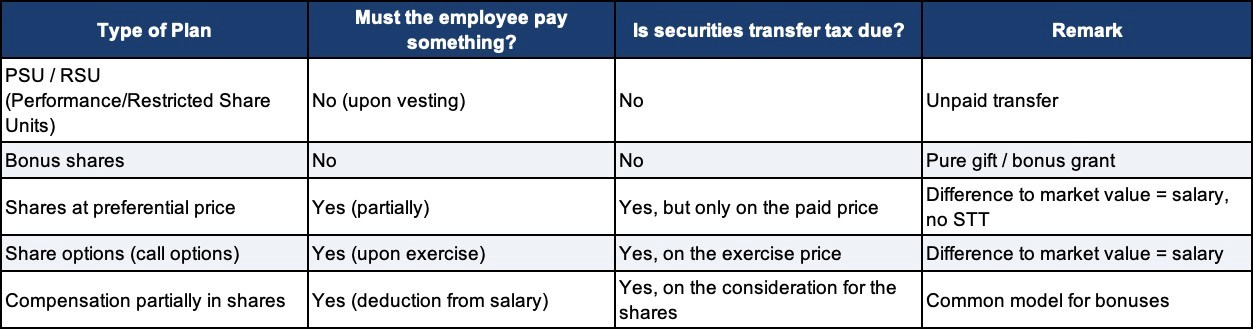
The ESTV clearly distinguishes between paid and unpaid transfers:
Unpaid transfers → No securities transfer tax: This includes, for example, bonus shares or the automatic conversion of Performance Share Units (PSU) or Restricted Share Units (RSU) into shares after a vesting period, without the employee having to pay anything.
Paid transfers → Securities transfer tax only on the amount actually paid: Important: The securities transfer tax is not levied on the taxable benefit (i.e., the difference between market value and the price actually paid by the employee). This benefit is considered a fringe benefit and must be declared in the salary certificate – but is not subject to securities transfer tax.
Overview: What applies to which plan?
What does this mean concretely for companies?
The good news: Many modern employee participation plans, especially those with PSU/RSU, are not affected by securities transfer tax because the transfer of shares takes place free of charge.
Nevertheless, there are pitfalls:
For plans with preferential prices or when exercising options, the securities transfer tax must be correctly calculated on the actual payment amount.
The distinction between salary tax and securities transfer tax must be cleanly documented.
For complex or larger plans, it is worth obtaining a tax ruling from the ESTV to create legal certainty.
Conclusion for practice: The new communication creates more legal certainty and shows: Not every transfer of employee shares automatically triggers securities transfer tax. The key questions are “Is something being paid?” and “Is a securities dealer involved?”.
Companies that have or are planning employee participation plans should have their existing arrangements reviewed now.
Do you have an employee participation plan in your company or would you like to introduce one?
We will be happy to check for you whether and to what extent securities transfer tax may be due and how you can structure your plan in a tax-optimal and legally secure manner.
LIBERTAS Treuhand advises you competently and practically – from conception to correct implementation and documentation.